Guinea Pig Farm

The 1991 OFA report ‘Microlivestock: Little-known Small Animals with a Promising Economic Future’ introduces several alternative small animals for domestication and meat and dairy production. Small animals are easier to breed and keep, and are a quick way of supplementing a diet, especially in less developed countries. One of the species of great interest to The Incredible Shrinking Man is the guinea pig, or Cavia porcellus.

In Latin America and a growing number of African and Asian countries guinea pigs are considered a delicacy and their meat fetches high prices. Cavies are clean and vegetarian. They have modest food requirements, although a year-round source of herbaceous feed is required. They breed easily. Over a period of 2 years one pair of guinea pigs can produce 260 new pairs. Ever since the introduction of Cavia porcellus to Europe in the 16th century they’ve become popular companions for kids and a model organism for researchers such as nobel prize winning microbiologist Robert Koch. What makes them good pets and test animals (their responsiveness to handling and feeding and the relative ease of caring for them) also makes them an excellent future alternative for larger domestic meat animals. As man becomes smaller, traditional farm animals like cows, pigs and sheep will be more difficult to handle and may need to be replaced. The guinea pig seldom exceeds 3 pounds in weight  (a little under the projected weight of The Incredible Shrinking Man) and many mature cavies are less than one pound. At birth the young weigh from 40 to 140 g, are fully developed, can see, smell, walk, run, eat, and even survive without the mother if necessary. The mature female comes into heat a few hours after giving birth. After mating, gestation takes about 68 days. The litter size varies from 1 to 7. Young cavies increase rapidly in body weight and, after setting aside the largest for breeding, they can be eaten at 3-4 months after birth. It is not advantageous to maintain them longer as they will grow slower and less efficiently after 4 months of age.

To learn more about the production of cavy meat The Incredible Shrinking Man recently opened its first  guinea pig farm in Amsterdam (May 2013). For more information contact us.

More on the production of Cavia porcellus in this elaborate Guinea Pig Management Manual.

Image for The Incredible Shrinking Man by Rooiejas/Jasper van der Berg.

  • Share/Bookmark

Ituri Zebras (Mbuti)

At an adult height of only 135-140 centimeters the Mbuti of Congo are about 30 to 35% shorter than an average person and among the shortest people alive today. Their average weight of only 40 kg constitutes a significantly more intelligent and efficient body design, needing far less resources to maintain itself. In our investigation on how to downsize the human body it is of the utmost importance to study the Mbuti, their genetic material and their environment and culture. Hopefully it teaches us how to become more like them.

The Mbuti consist of several different ethnic entities, the Efé, the Mbuti and the Asoa. What connects them are the extreme conditions of their natural environment living in the warm, moist and dark Ituri rainforest. The Incredible Shrinking Man is conducting several experiments involving zebrafish to understand how this specific environment may have contributed to the aw inspiring ability of Mbuti people to neutralise the overproduction of growth hormone. Zebrafish are the world most popular model organism representing mankind in innumerable genetic experiments. We’re trying to reproduce aspects of the Ituri Forest environment in a series of fish tanks, changing light conditions, water temperature, diet and other ingredients of this promising habitat. By introducing zebrafish larvae into slightly different conditions based on the forest we hope to understand better how these specific conditions have created people that may very well become the model for a future mankind.

Link to the Paris Experiment.

Link to the Amsterdam Experiment.

  • Share/Bookmark

Abundance Fantasies: The Grapes of Canaan

Our desire for abundance represents both the cause for the planet’s perilous condition and the incentive for a possible solution. If (despite Earth’s dwindling resources) we want to continue our present lifestyles, and the desire for abundance is stronger than the desire for being tall, eventually we’ll be forced to seriously consider shrinking the human body into abundance. The Abundance Fantasies collects stories and images on the desire of abundance throughout human history. Although this longing seems obvious, perhaps it is not. Not all cultures have displayed an equal desire for abundance and not all cultures are willing to sacrifice the health of the planet to be able to consume more than they need.

Among the most influential historical abundance fantasies is the story of the Grapes of Canaan in the Old Testament. The story describes how Moses, who led the Jews out of Egypt into the Sinai desert, sends out 12 spies to Canaan to learn if the land they are looking to conquer is fertile and rich in produce. The spies return with a cluster of grapes so heavy that it must be carried by 2 man. ‘And they told him, and said: We came unto the land whither thou sentest us, and surely it floweth with milk and honey; and this is the fruit of it.’ Today it is the overconsumption of milk and various sugars that is fuelling our unnatural tallness. More importantly the story shows that the imagination of abundance has its roots in scarcity.

  • Share/Bookmark

Short Hearts

Despite what many of us think, tall stature is not synonymous with health. Although anthropometric historians like Robert Fogel and John Komlos stress that the reasons why we are so tall are the result of better health, this doesn’t mean that being tall itself is healthy. There’s a crucial difference between cause and effect.

A look at cardiovascular heart disease (CHD) shows the complexity of the issue. Although there are many western studies showing a negative correlation between height and CHD, these correlations do not prove causation. On the contrary, when shorter people are compared to taller people, a number of biological mechanisms evolve favouring shorter people. Short people have a higher heart pumping efficiency because the hearts of shorter people are scaled to their body weight. Thus, they have to pump an amount of blood in proportion to their body volume. Shorter people’s hearts do not have to pump blood as high as the hearts of taller people. In accordance with scaling laws taller people’s hearts have to work harder; a 10% taller person of the same body proportions as a shorter person has to pump 33% more blood 10% farther. Yet, the heart’s muscle strength is only 21% greater thus relatively weaker. Other advantages to being short include lower atrial fibrillation, lower DNA damage, lower risk of thrombus, lower left ventricular hypertrophy and superior blood parameters.

The causes of increased heart disease among shorter people in the developed world are therefor not related to height but to such things as lower income, excessive weight, poor diet, lifestyle factors, childhood illness and poor environmental conditions. In fact, perhaps short stature of these people is a natural survival mechanism to help the heart deal with poor conditions. If they’d grow taller despite these conditions they’d die a lot sooner. The findings of an Indian paper indicate that shorter height appears to be an advantage for avoiding CHD under traditional lifestyles. However, short people following a Western diet and poor health habits are at increased risk due to high fat, calorie diets and excessive weight. Not surprisingly poor Western lifestyle at the moment favours the tall.

  • Share/Bookmark

Hourglass, Banana, or Spoon?

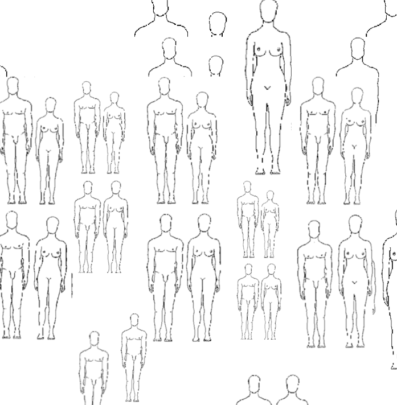
Even within a speculative research such as The Incredible Shrinking Man it is difficult to imagine what the average human body will look like if we decide to shrink to 50 centimetres. However, based on the specific physical adaptations to environment and our various diets and different functionalities of the human body, perhaps some presumptions can be made, even if just to open the imagination towards our future appearance. In fact throughout history, our imagination in myths, legends and fairy tales has envisioned a wide variety of small human creatures. It would be ignorant to dismiss these descriptions and visualisations as mere fantasies. From an evolutionary perspective all life started small and perhaps these manifestations are a vehicle for lost knowledge on our small self and the hyper-variable possibilities of the human body.

On the other hand biological functionality will make some developments of the body more probable than others. Most small mammals have an agility and quickness that seems related to greater relative strength and the elegance of Haldanian simplicity. Will we experience what Heinrich von Kleist in his On the marionette theatre calls the ability to not be ‘afflicted with the inertia of matter’?  Or will we develop in another direction with relative large heads to facilitate our relatively large brain, and wider hips for women to facilitate birth? Will we retain more fat to protect ourselves from hypothermia? Or will our eyes become bigger and move to the side of the head to be able to respond to danger more quickly? As always there are more questions than answers. Please join our discussion. Speculative modelling on the general appearance of the future shrunken human body will kick off during ALIVE/En Vie opening April 25th 2013.

In cooperation with Floris Kaayk.

  • Share/Bookmark

Japanese Miniatures #02: Immortal Bonsai

A tree in nature and growing under perfect conditions, will grow until it reaches the predetermined height and width for that species within the given environmental circumstances. Upon reaching full potential the now massive amount of foliage at the incalculable number of branch tips is just too vast. The tree starts to weaken and eventually dies because the foliage has grown too far away from the active roots. Conversely a bonsai tree, which is prevented from ever reaching its maximum dimensions through regularly pruning of the roots and and branches, could theoretically live forever. The careful and calculated care management keeps the bonsai in a constant state of growth, because the bonsai, just like its full-size cousin, is genetically programmed to achieve maturity. The essential difference is: by preventing the bonsai from reaching maturity, you are preventing it from ever reaching old age and falling victim to the troubles that inevitably go along with the aging process.

Within Japanese philosophy there’s a notion that to cultivate a bonsai tree is in fact to cultivate yourself. The bonsai represents man. Therefor it is of some interest to The Incredible Shrinking Man to investigate if, and how, this cultivation of a smaller self relates to the idea of shrinking the human body, as well as nurturing the desire to do so. Perhaps the aesthetic pleasure exprienced in bonsai can be extended to experiencing aesthetic pleasure from shorter human beings. To some this might seem like a stretch; why would miniaturising a tree have anything to do with a desire to shrink the human body? Perhaps nothing, yet on an abstract level there’s an interest in the inter-relatedness of these deeply rooted notions of survival as well as its connection to the idea of becoming immortal. If we continue to grow as we do at present, at some point survival is indeed what is at stake. Perhaps we should remain in a permanent state of physical immaturity, never quite reaching our full potential, and at the same time, paradoxically, allowing ourselves to continue to grow forever.

  • Share/Bookmark

Fish Representatives

In most genetics research, Homo sapiens is represented by small fish like Danio rerio (zebrafish)  and Oryzias latipes (Japanese rice fish). Both are important model organisms, representing man in developmental genetics, neurophysiology and biomedicine. When we tinker with genes what happens to the fish is most likely to happen to us as well. If the fish remains small because of a certain genetic alteration there’s a good chance the same alteration will affect human growth as well. But just as important as the genetics are the epigenetics: all mechanisms that cause heritable changes through gene expression without affecting an actual change  in the DNA itself. In other words, how are we affected by the environments we grow up in.

Fish are perfect in showing us how environment influences growth. Fish in a small aquarium stay smaller. Temperature is also an issue. Bergmann’s rule states that species tend to shrink when temperatures rise. Global warming already has this effect on fish species around the world. Light is also an important factor. Red light stuns growth is most fish species, which is interesting because Dr. Julian O’Dea thinks that perhaps the reason that Pygmy are much smaller than average human height is because they live in low light situations in the deep forest.

Running up towards EN VIE/ ALIVE (an exhibition curated by Carole Collet that examines the impact of new biological tools on design and fabrication for the future) The Incredible Shrinking Man will open a zebrafish lab to research how specific environmental conditions like temperature, light, living space and sound influence growth. Perhaps our fish representatives will show us how to live smaller lives in the future.

  • Share/Bookmark

Towards Weightlessness

Seeing Jane Fonda’s clumsy striptease in the opening scene of the sci-fi classic Barbarella arouses laughter rather than anything else, but it does trigger a desire to break free from gravitational inhibitions. Weightlessness is defined by the absence of stress and strain resulting from externally applied forces. The desire to experience such freedom is deeply rooted in our collective fantasy. It’s no wonder we increasingly fantasise about being weightless. Our large bodies are under so much pressure that our inclination towards growth is pushing the limits of the physically possible. With the possible exception of professional basketball players most people over 200cm move around rather clumsily and the really tall are more or less cripple. At 50cm the human body weighs 2 kg’s but because of our radically increased relative strength and better motor skills we’d feel empowered and the strain on our limbs would be next to nothing.

In On the Marionette Theather Heinrich von Kleist makes a brilliant comparison between dancers and puppets and coincidentally paints a picture of a possible human future much more elegant than the elephant-like movements of us giants: “these puppets have the advantage of being for all practical purposes weightless. They are not afflicted with the inertia of matter, the property most resistant to dance. The force which raises them into the air is greater than the one which draws them to the ground.” … “Puppets need the ground only to glance against lightly, like elves, and through this momentary check to renew the swing of their limbs. We humans must have it to rest on, to recover from the effort of the dance. This moment of rest is clearly no part of the dance. The best we can do is make it as inconspicuous as possible…”

  • Share/Bookmark

The Raw Tom Outrage

RAUWER

Tom Watkins is a 15 year old kid from Amsterdam that’s being raised by his single mother on a Raw food vegan diet. Raw foodies eat uncooked, unprocessed organic foods as a large percentage of the diet. The idea is that raw food is healthier than cooked food because it doesn’t destroy nutrients and doesn’t contain as many carcinogens as cooked food. The interest for The Incredible Shrinking Man is also what makes Tom the protagonist in a story of national outrage: because of his diet he might end up 6 to 12 centimeters shorter as an adult than he could be if he would eat dairy and meat like other children.

Considering our obsession with being tall and growth it’s not surprising that most people are appalled by Tom’s modest growth curve. The boy’s mother has been accused of experimenting with the boy’s health. However, she’s probably right in claiming that not she but most other parents are experimenting with allowing their children to eat historically unprecedented large quantities of fat, sugars, and proteins. We’ve long passed the point where tall means healthy. In fact statistically Tom’s 12 cm loss in height translates into a longer average lifespan of 6 years. Short people live longer. And because of Tom’s decreased height during this longer life he will consume considerably less food, need less energy and create less waste. Tom is a pioneer.

  • Share/Bookmark

One Bean Coffee

According to the Water Footprint Network the fresh water involved in the production of a single cup of coffee (125ml) is 140 liters. One part of coffee consumes 1100 water parts. To make an average cup of coffee requires around 40 coffeebeans. To produce one bean requires 3,5 liters of water. In total the global consumption of coffee requires about 110 billion cubic metres of water per year. That is the equivalent to the water that flows from the river Rhine over a period of 18 months.

According to our calculations, and because of proportional shrinkage of the body, The Incredible Shrinking Man will consume only 2% of contemporary man’s coffee needs. Such a dramatic reduction in the use of water resources has obvious environmental and economic advantages, but just as important, there’s poetry in having a cup of coffee that is made from one single coffee bean.

  • Share/Bookmark